

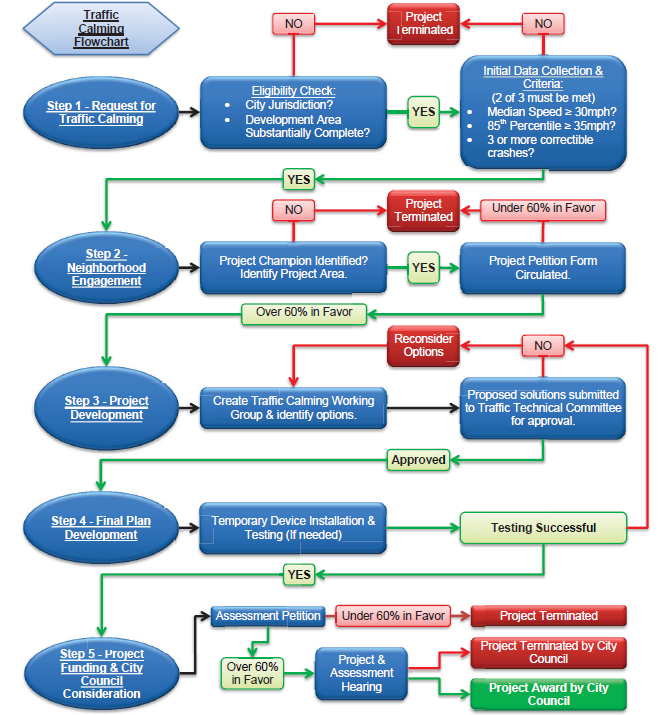
Typically, traffic calming requests begin with a phone call, email, or visit to the Engineering Department with a complaint about perceived excessive speed, cut-through traffic, or a safety issue on a neighborhood street. The City has also established an on-line request form. All candidate requests are referred to the Traffic Engineer to determine if the traffic calming program is the appropriate tool for the conditions described in the complaint.
The traffic calming process begins by verifying that the requirements of Article II are satisfied. Engineering staff will collect preliminary data to characterize current conditions. This data may include, but not be limited to, location, description of the problem, crash data, bicycle volumes, pedestrian activity, traffic speed, and traffic volume.
Traffic calming projects are intended to respond to traffic issues related to speeding and/or excessive non-local traffic on one street or intersection within a neighborhood. Solutions may include modifications to the street to slow traffic or to divert through traffic from the subject street to a nearby collector or minor arterial street. Traffic calming projects will only be considered insofar as the improvements do not divert a “significant volume” of traffic from the study street to another local street. The definition of a “significant volume” of traffic will be established by the participating neighborhood group (in step 2) with the assistance of the Traffic Engineer. A traffic calming plan which is estimated to cause significant diversion to another neighborhood street may result in the termination of a traffic calming study.
Upon completion of initial data collection and analysis, a determination will be made to either continue the traffic calming process, or terminate and close the request (if the criteria in Article II are not satisfied). The requestor will be notified of the Step 1 determination in writing.